
 English
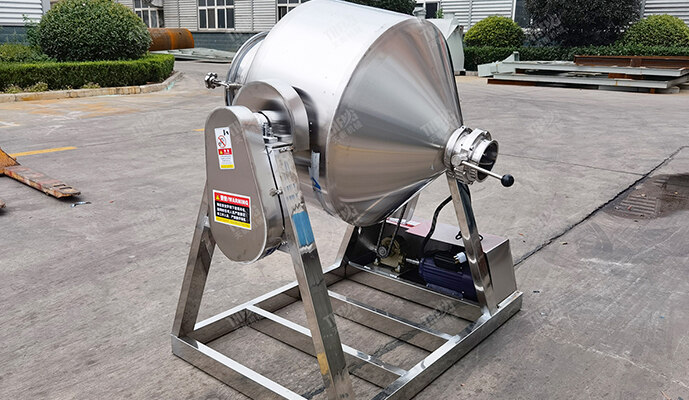
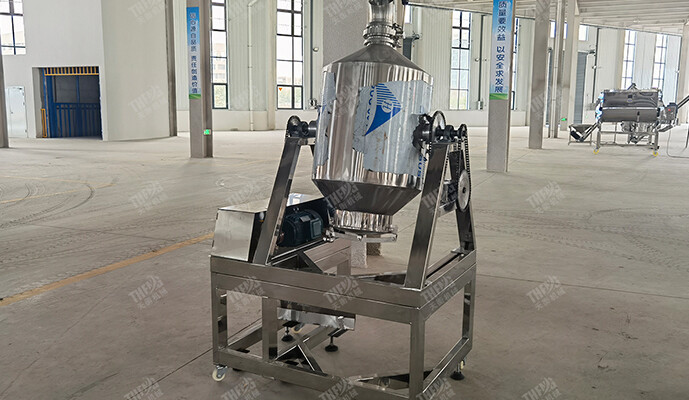
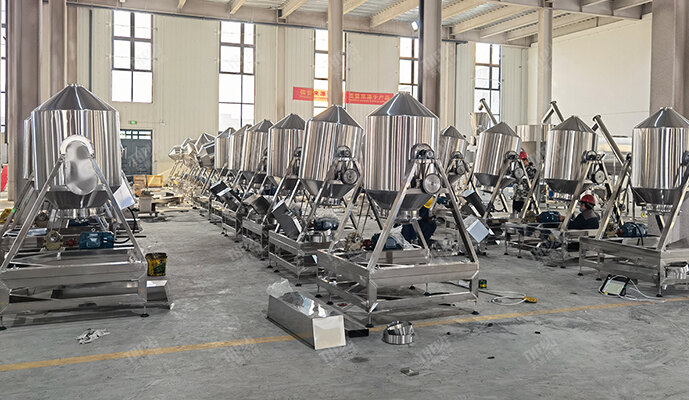
The core component of a drum mixer is a rotatable “drum” (i.e. mixing drum). It rotates the mixing drum around the central axis through the driving system, and uses the rotational motion of the blades or the drum itself to lift, sprinkle, impact, and friction the materials inside, thereby achieving uniform mixing of materials. It is a batch (intermittent) mixing device, which unloads the material after completing one batch of mixing, and then proceeds to the next batch of operation. This working mode is very suitable for production scenarios with fixed formulas and high requirements for uniformity.
Core structure
1. Mixing drum: the “studio” where mixing occurs. Usually welded from wear-resistant steel plates, it is equipped with various forms of blades or liners according to different needs to ensure efficient mixing motion.
2. Drive system: the “heart” of the device. Including motors, reducers, transmission gears, etc., provide smooth and reliable power for the rotation of the mixing drum.
3. Rack and support device: the “skeleton” of the equipment. Used to support the weight of the entire mixing drum and its internal materials, it is usually achieved through a roller and idler system for smooth rotation.
4. Feeding and unloading device: the “inlet and outlet” of materials. The feed port is usually located above one end of the cylinder, while the discharge port is often located below the other end, controlled by pneumatic or electric valves to ensure smooth and residue free discharge.
5. Control system: the “brain” of the device. Modern drum mixers are usually equipped with PLC (Programmable Logic Controller) and touch screens, which are used to set mixing time, speed, start stop and other parameters to achieve automated operation.
Working principle
1. Loading: Various pre weighed raw materials are fed into the mixing drum through the feeding system or manually from the feeding port.
2. Mixing: Start the equipment and the mixing drum begins to rotate. The material inside the cylinder is carried to a certain height by the internal blades during the rotation process.
3. Diffusion and Shear: When the material is lifted to the top, it is thrown downwards under the action of gravity (diffusion mixing). At the same time, relative sliding and collision (shear mixing) occur between material particles and between particles and cylinder walls and blades. This composite motion of “throwing rolling shearing” repeats itself, allowing materials of different compositions to reach a highly uniform state in a short period of time.
4. Unloading: After reaching the preset mixing time, the mixing drum stops rotating and is positioned with the discharge port facing downwards. The discharge door is opened, and the mixed finished product is discharged under the action of gravity and enters the next process.
Advantages and limitations
Advantage:
High mixing uniformity: especially suitable for mixing solids with solids, or small amounts of liquids with solids.
Large processing capacity: The processing capacity of a single batch can range from tens of liters to several cubic meters, with flexible scale.
Wide applicability: By replacing the blades or liners inside the cylinder, it can handle a variety of materials from powders, particles to slurries. Simple operation and maintenance: The structure is relatively simple, the operation is reliable, and the daily maintenance cost is low.
limitations:
Intermittent work: Not suitable for production lines that require continuous feeding and discharging.
There may be blind spots: When the design is poor, there may be mixing blind spots inside the cylinder, which affects the final uniformity.
For ultrafine powders or highly viscous materials: it is prone to problems such as wall sticking and agglomeration, requiring special design.
Application field
|
Building materials |
concrete, dry powder mortar, refractory materials, asphalt mixture |
|
Chemical industry |
fertilizers, plastic pellets, dyes, pigments, detergent raw materials |
|
Metallurgical mines |
mixing of mineral powder before sintering |
|
Food industry |
flour, feed, seasoning, additives |
|
Environmental Protection Industry |
Homogenization Treatment of Solid Waste |
In summary, drum mixers, as a long-standing and enduring mixing equipment, continue to play a key role in modern industrial production due to their reliability and effectiveness. With the development of automation and intelligent technology, future drum mixers will be more efficient, energy-saving, and clean, continuing to provide solid foundation support for the development of various industries.