
 English
In numerous process industries such as chemical engineering, pharmaceuticals, and food, liquid stirring tanks are core equipment that can be seen everywhere. To the layman, it might just be a large barrel with stirring blades, but every structural detail inside it embodies profound knowledge of fluid mechanics and technology. Today, let’s explore how the agitator tank can become an efficient mixing artist through ingenious design.
The shape of the tank and the height-to-diameter ratio
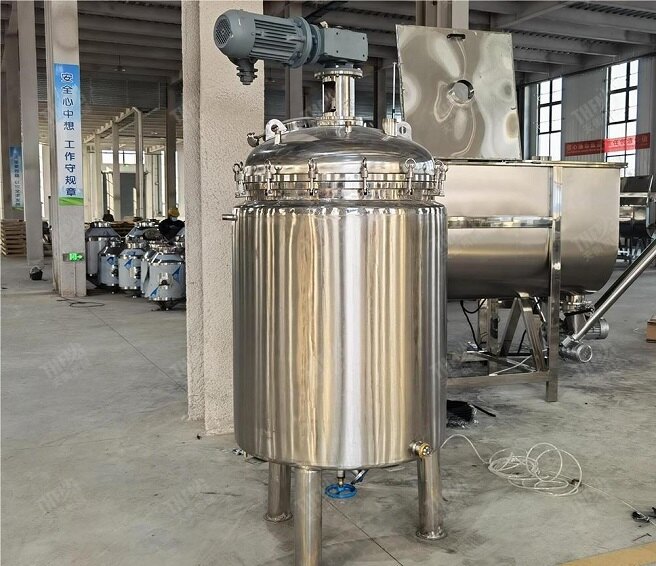
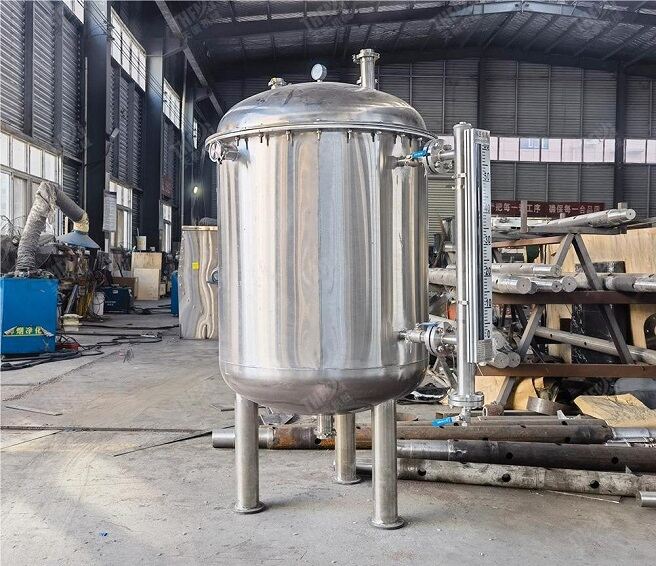
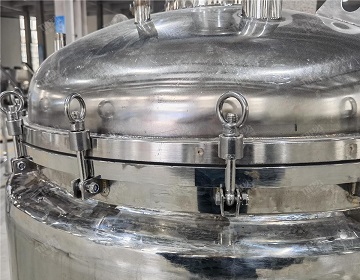
Shape: The vast majority of agitator tanks adopt flat-bottomed oval heads. The flat bottom facilitates the standing of the equipment and the installation of internal components (such as coils and bottom bearings). Elliptical heads have a good force distribution, are easy to manufacture and clean, and can guide the fluid to form a smooth circulation at the same time.
Height-to-diameter ratio: This refers to the ratio of the liquid level height inside the tank to the diameter of the tank body. This parameter is the key to determining the stirring efficiency and power consumption.
Large height-to-diameter ratio: It is suitable for processes that require a longer residence time, such as fermentation and suspension polymerization. However, the upward and downward circulation path of the fluid is long, which is prone to generating mixing dead zones in the axial direction. Usually, multiple agitators or specific impellers need to be used in conjunction.
Small height-to-diameter ratio: It is suitable for processes that require strong surface renewal, such as gas-liquid dispersion or situations where axial mixing is not highly demanded. Its fluid circulation path is short and the mixing speed is fast.
Conventional choice: For most conventional mixing and heat transfer processes, an H/D ratio between 1:1 and 1:3 is a common and balanced choice, which can achieve a good balance between power and effect.
Jacket heating and cooling
Many stirring processes are accompanied by heat input or output, and the jacket is the most commonly used temperature control structure. It is a closed space formed by wrapping another layer around the outer wall of the tank, allowing the heat transfer medium (such as steam, cooling water, and heat transfer oil) to flow within it.
Types: Common ones include ordinary jacket, spiral guide plate jacket, half-pipe jacket, etc. The half-tube jacket is widely used in situations requiring high temperature and high pressure due to its strong pressure-bearing capacity and high heat transfer efficiency.
Advantages: The jacket structure does not come into direct contact with the materials inside the tank, avoiding contamination, and provides a huge heat transfer area, ensuring uniform and stable heating/cooling.
Limitation: For high-viscosity materials, the heat transfer efficiency of the jacket may decline. In such cases, it may be necessary to add additional internal coils to enhance heat transfer.
The core function of the baffle
If you observe a stirring tank without a baffle in operation, you will find that a deep vortex forms at the center of the liquid surface, and the stirring shaft also sucks in air as a result. This phenomenon seems interesting, but in fact, it is extremely harmful:
1. The mixing efficiency dropped sharply, and most of the energy was consumed in the formation of vortices.
2. Inhaling air may cause oxidation or contamination of the materials.
3. It causes the stirring shaft to vibrate, shortening the service life of the equipment.
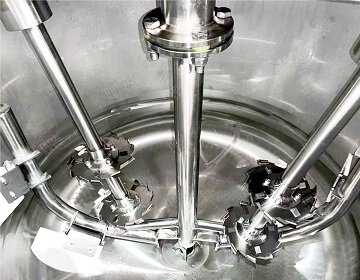
The baffle is precisely designed to solve this problem. They are usually several long steel plates vertically installed on the tank wall. Its mechanism of action is to disrupt the tangential circulation flow of the liquid, converting it into vigorous axial and radial flows, thereby completely breaking the vortex.
A deflector for guiding the flow
If the baffle is the “destroyer”, then the deflector is a precise “guide”. It is a cylinder fixed in the tank and surrounding the agitator. Its function is to set a path for fluid flow and force the fluid to circulate along the predetermined path.
1. For axial flow impellers, the deflector tube can confine the downward jet, allowing it to reach the bottom of the tank directly, and then return upward from the annular gap between the deflector tube and the tank wall, forming a highly regular flow field with a huge circulation volume.
2. It almost eliminates short-circuit flow and dead zones, ensuring the ultimate improvement of material uniformity inside the tank.
Application scenarios of the deflector cylinder:
1. In situations where extremely high uniformity of mixing is required, such as the preparation of high-end chemicals and pharmaceuticals.
2. Solid suspension: It can effectively lift the solid particles at the bottom of the tank and homogenize and suspend them.
3. Gas-liquid dispersion can significantly increase the residence time of gas and the dispersion effect.
Related product recommendations
500L Stainless Steel Liquid Mixing Tank
Powder and liquid mixing production line
An efficient liquid stirring tank is by no means a simple tank body plus an impeller. It is a complex system that is based on the shape of the tank and the height-to-diameter ratio, achieves energy exchange through the jacket, relies on baffles to break bad flow patterns, and can precisely control the flow with a deflector cylinder. The collaborative design of these key structures jointly determines the success or failure of the stirring process. Understanding these is the key to equipment selection, process optimization and even fault diagnosis.